Christopher Olaf Blum’s essay “Newman’s Collegiate Ideal” explains that Newman’s focus on friendship enabled the university to be “not a chance collection of individuals building their careers, but a kind of fellowship, even a friendship, whose characteristic activity was to ‘rejoice in the truth’ (gaudium de veritate).” Common meals were the soil where acquaintanceship grew into friendship, which Aristotle understood to be among the highest of life’s rewards. Genuine learning without the “pure and clear atmosphere of thought” fostered by true friendship was difficult to achieve. Like Origen, Newman understood that “personal influence… was the means of propagating the truth.”The best thing that ever happened to me, intellectually, was that my friends and I had to take the same classes and read the same books. Our discussions gave me a stake in my coursework, which touched off a cycle. Imagining higher education based on a principle of friendship — why, one might think that the striving for wisdom is the second paradise of world.
In an age of unmanageable class sizes and overworked (and out of work) professors, advocating such an intimate scale of virtue-based learning may seem naive. Yet such ideals are probably closer to most of our own learning histories than we might think. If a given class distilled more than mere information, but instead shaped our lives and futures, some kind of friendship probably played a role. Wherever our own education occurred, or is occurring, transformative learning continues to happen as it always has—through communities of friendships upheld by some measure of mutual virtue.
14 April 2011
Milliner on friendship and education.
Public Discourse has a new essay by Matthew Milliner, one section of which I'd like to endorse:

“Still the picture flips.”
Now that I've written this post, I don't feel like blogging on the Mountain Goats' new album All Eternals Deck anymore, which works well, since this is the last song on the album.
With “Liza Forever Minnelli,” we’ve got a song about someone wandering around Los Angeles, feeling stuck and lonely, and eventually lying down with his cheek to Liza Minnelli's walk-of-fame star because he or she feels some connection to the actress. It's a sweet and sad image, as fitting for the close of the album as the fury of “Damn These Vampires” was for the start.
And so that's the new album. I hope I've convinced someone to give it a listen or two, but if not, that's all right.
With “Liza Forever Minnelli,” we’ve got a song about someone wandering around Los Angeles, feeling stuck and lonely, and eventually lying down with his cheek to Liza Minnelli's walk-of-fame star because he or she feels some connection to the actress. It's a sweet and sad image, as fitting for the close of the album as the fury of “Damn These Vampires” was for the start.
And so that's the new album. I hope I've convinced someone to give it a listen or two, but if not, that's all right.
13 April 2011
All Eternals Deck, part twelve of thirteen.
I'm blogging on The Mountain Goats' new album All Eternals Deck until I feel like stopping.
I feel weird writing about “Never Quite Free.” You see, this song is not for me. It's for survivors. So if this song sounds like a series of positive-thinking platitudes — “you'll sleep better when you think you've come back from the brink,” “it's so good to learn that from right here the view goes on forever” — I have to admit that maybe I should just let a comforting song be a comforting song.
But that reading doesn't quite hold. You've got the title of the song, and the ominous warnings: “when you see him, you'll know.” Life gets better, the careful listener hears, but the past will sneak up on you. This aspect of the song plays against the optimistic sentiment of the poppy arrangement, to moving effect. The music asks us to forget the darkness completely, but the lyrics tell us to think twice.
And, once again, there's something eschatological in all this.
I feel weird writing about “Never Quite Free.” You see, this song is not for me. It's for survivors. So if this song sounds like a series of positive-thinking platitudes — “you'll sleep better when you think you've come back from the brink,” “it's so good to learn that from right here the view goes on forever” — I have to admit that maybe I should just let a comforting song be a comforting song.
But that reading doesn't quite hold. You've got the title of the song, and the ominous warnings: “when you see him, you'll know.” Life gets better, the careful listener hears, but the past will sneak up on you. This aspect of the song plays against the optimistic sentiment of the poppy arrangement, to moving effect. The music asks us to forget the darkness completely, but the lyrics tell us to think twice.
And, once again, there's something eschatological in all this.
Gifts of the internet.
Dr. Boli posts an advertisement from the borough police, who are selling some special services to the public as a way of making up their budget shortfall. Services include "Motorcades for Prom Night" and "Rivals Discouraged." Act now!
12 April 2011
"For Charles Bronson"
I'm blogging on The Mountain Goats' new album All Eternals Deck until I feel like stopping.

ehrenfeld, pennsylvania, scratched into my face
It's a song for Charles Bronson. You either get the appeal or you don't, I suppose.
(The picture grabbed from the awesome blog "If we don't, remember me.")
...and please forgive me for adding this:

It's a song for Charles Bronson. You either get the appeal or you don't, I suppose.
(The picture grabbed from the awesome blog "If we don't, remember me.")
...and please forgive me for adding this:
Weekend movies.
Your Highness
Out of a sense of loyalty to David Gordon Green that now appears to be quite misguided, I went to see Your Highness last Friday evening. I didn't find it boring, and parts of it were wild enough to be funny, but overall... well, star Danny McBride explains it pretty well.
All the Real Girls was the first David Gordon Green film I saw, and along with Green's other early movies George Washington and Undertow it's part of an impressive trio of Southern films. McBride is in All the Real Girls, and he's great. But after getting in on Seth Rogan's Pineapple Express, it looks like Green and McBride jumped at the chance to have studios give them tons of money to put an old joke on the big screen. Surely it's fun to make this kind of movie -- coming up with the costumes, goofing off with James Franco, wandering up and down hills in Ireland, etc. -- but I wish Green would undo his regression. Looking at his next few projects, I'm not optimistic. From here on out, I guess I'm setting my hopes on Junebug director Phil Morrison's triumphant return to the big screen.
Certified Copy
I don't remember the last time I saw a movie twice in the theaters, but I'm definitely going back for another viewing of Certified Copy. At this point I can't say I have a solid theory on what's going on. I can tell you that a man and a woman wander around Tuscany talking about art, and eventually about more, but whether the movie should finally be judged as realism, pastiche, or something else, I can't yet say. Oh, and the woman is Juliette Binoche. I'll be writing more on this one after I see it again.
Out of a sense of loyalty to David Gordon Green that now appears to be quite misguided, I went to see Your Highness last Friday evening. I didn't find it boring, and parts of it were wild enough to be funny, but overall... well, star Danny McBride explains it pretty well.
“And then he's explaining Your Highness, as best he can. How it all started as a joke. How he and his old film-school buddy David Gordon Green [...] used to play this movie-nerd game years ago, where Green would throw out a title and McBride would start pitching him back 'f— retarded ideas for movies.'
“Green would say something like Face of Danger, and they'd come up with ‘some weird story about Steve Danger, who's a plastic surgeon and he solves mysteries.’ Your Highness was one of those. Green said it; McBride said, ‘What if I was in the Middle Ages fighting dragons and getting stoned all the time?’ ”
All the Real Girls was the first David Gordon Green film I saw, and along with Green's other early movies George Washington and Undertow it's part of an impressive trio of Southern films. McBride is in All the Real Girls, and he's great. But after getting in on Seth Rogan's Pineapple Express, it looks like Green and McBride jumped at the chance to have studios give them tons of money to put an old joke on the big screen. Surely it's fun to make this kind of movie -- coming up with the costumes, goofing off with James Franco, wandering up and down hills in Ireland, etc. -- but I wish Green would undo his regression. Looking at his next few projects, I'm not optimistic. From here on out, I guess I'm setting my hopes on Junebug director Phil Morrison's triumphant return to the big screen.
Certified Copy
I don't remember the last time I saw a movie twice in the theaters, but I'm definitely going back for another viewing of Certified Copy. At this point I can't say I have a solid theory on what's going on. I can tell you that a man and a woman wander around Tuscany talking about art, and eventually about more, but whether the movie should finally be judged as realism, pastiche, or something else, I can't yet say. Oh, and the woman is Juliette Binoche. I'll be writing more on this one after I see it again.
11 April 2011
"Up they come, gone translucent."
I'm blogging on The Mountain Goats' new album All Eternals Deck until I feel like stopping.
When you see the song title "Outer Scorpion Squadron," you might expect something about spacemen, or maybe a story about fighting giant arthropods in the old west. What you probably wouldn't expect is a quiet meditation on a man's simultaneously nurturing and combative relationship with his most painful memories. But that quiet meditation is exactly what you get, and this song has become one of my favorites in the Mountain Goats catalog. It seems that you could think of "Outer Scorpion Squadron" as an epilogue to The Sunset Tree.
When you see the song title "Outer Scorpion Squadron," you might expect something about spacemen, or maybe a story about fighting giant arthropods in the old west. What you probably wouldn't expect is a quiet meditation on a man's simultaneously nurturing and combative relationship with his most painful memories. But that quiet meditation is exactly what you get, and this song has become one of my favorites in the Mountain Goats catalog. It seems that you could think of "Outer Scorpion Squadron" as an epilogue to The Sunset Tree.
09 April 2011
The firepit and the forge.
I'm blogging on The Mountain Goats' new album All Eternals Deck until I feel like stopping.
“Sourdoire Valley Song” is not the first Mountain Goats song about someone long-dead whose remains we've found. The album Sweden has another good one, “Tollund Man.”


Just for comparison, by the way, I learned that the Homo habilis remains at Olduvai Gorge are dated between 3,200,000 and 1,600,000 years ago. The Old Man of La Chapelle-aux-Saints is estimated to have died about 60,000 years ago, which puts him much, much closer to us than to H. habilis. Tollund Man was killed in about 2,400 years ago.
“Sourdoire Valley Song” is not the first Mountain Goats song about someone long-dead whose remains we've found. The album Sweden has another good one, “Tollund Man.”
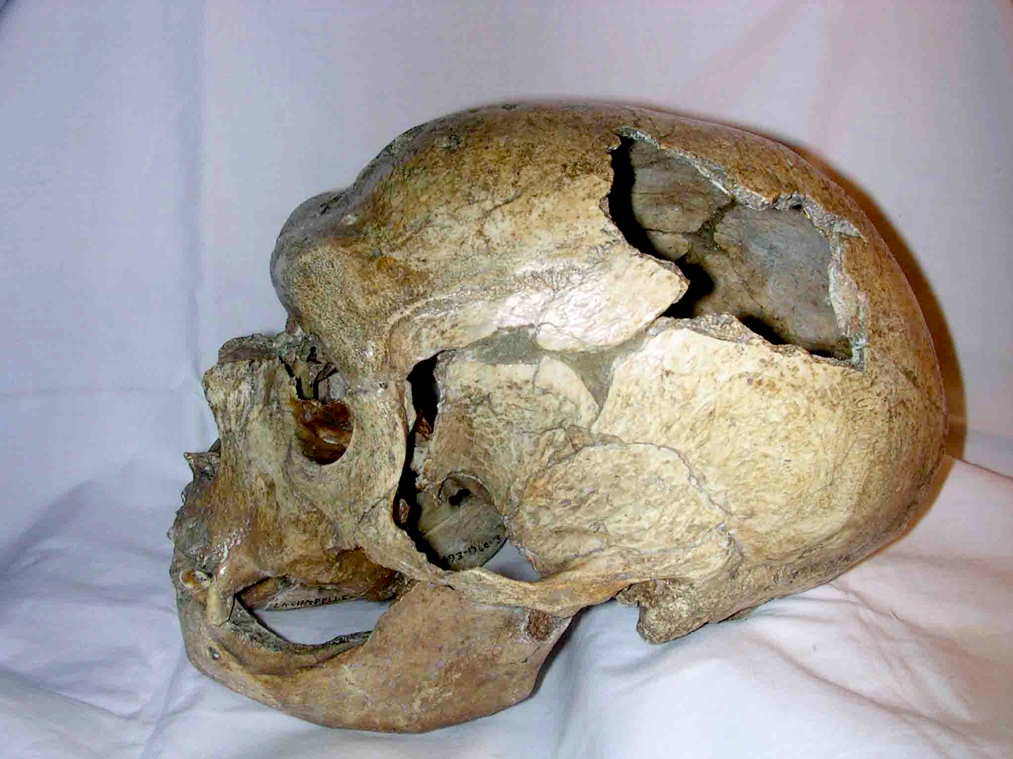
take care of the old man, see if he's in pain
have somebody stay with him, comfort him when he complains
keep to ourselves mostly: few friends and fewer closer friends
lead a long life if you're lucky, hope it never ends
and then the grass grows up to cover up the firepit and the forge
half a world away from the olduvai gorge
-"Sourdoire Valley Song" by The Mountain Goats
"The Old Man had lost most of his molar teeth before death, suffered from severe arthritis of the lower neck, back, and shoulders, had lived long enough to heal a broken rib, and had a badly deteriorated left hip. Without question, the Old Man had had a hard time of it."
-Erik Trinkaus and Pat Shipman, The Neandertals: Changing the Image of Mankind. New York: Alfred A. Knopf, 1993. (191)
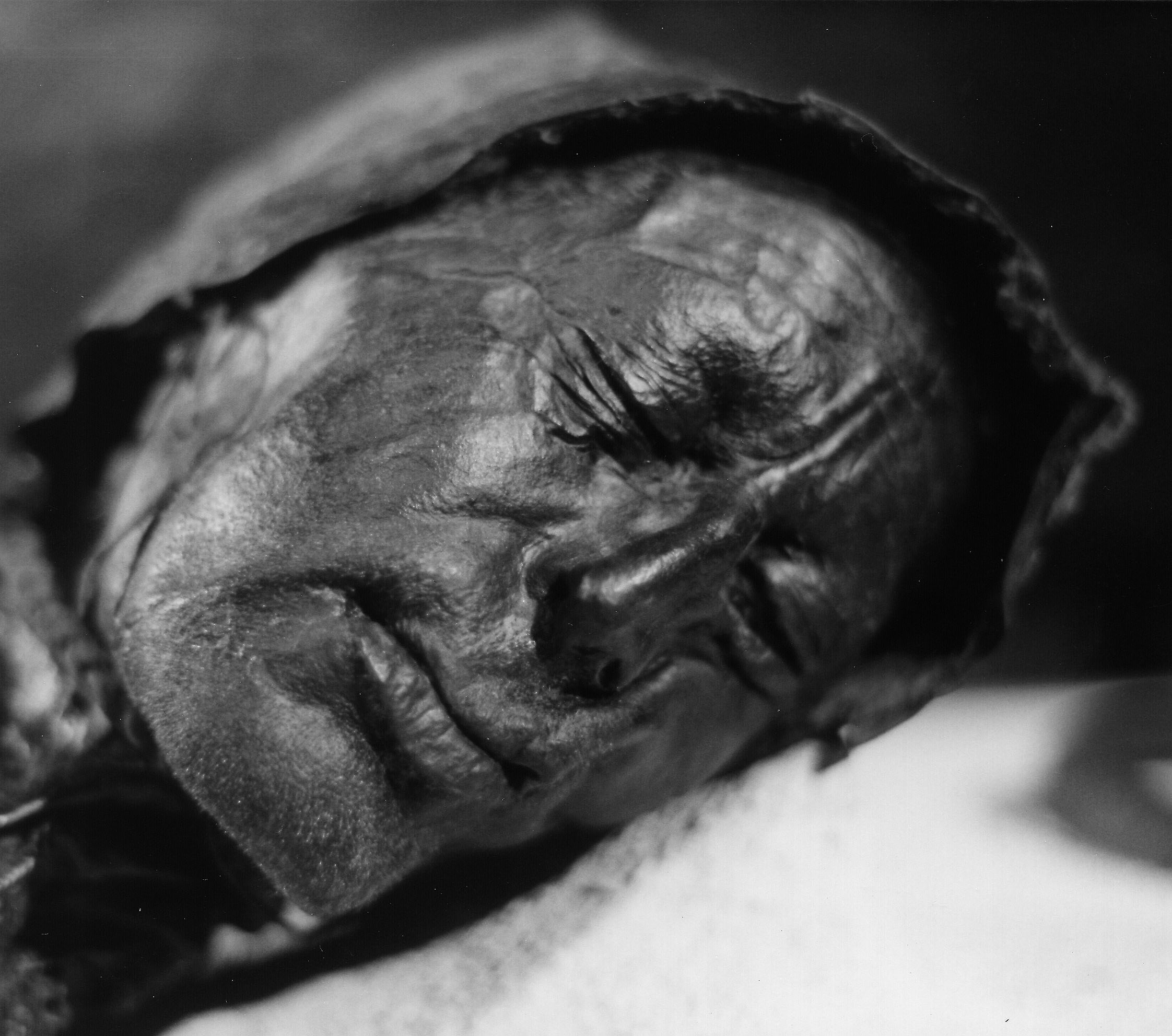
goodbye young danish women
goodbye danish sky
goodbye cold air I am going away
goodbye goodbye goodbye
-"Tollund Man" by The Mountain Goats
“The features are all intact in skin tanned black by the humic acid of a type of 'sour' bog found only in north-west Europe. You look on a man who was not unhandsome, with an aquiline nose, a well-formed mouth and lips, long in the cheek and with a good depth of brow that still shows in every furrow. Even the hat he wore, a pointed cap of pieces of sown hide, is preserved on his head. The wrinkled lids of the eyes have closed as in sleep. The face has a peaceful expression that belies the fact that his end came violently — a rope of twisted leather was round his neck. He was strangled: whether for a crime or for a sacrifice, we will never know. One thing autopsy did reveal about him is that he had a last meal of a kind of porridge.”
-Colin Simpson, The Viking Circle. New York: Fielding Publications, Inc., 1966. (44)
Just for comparison, by the way, I learned that the Homo habilis remains at Olduvai Gorge are dated between 3,200,000 and 1,600,000 years ago. The Old Man of La Chapelle-aux-Saints is estimated to have died about 60,000 years ago, which puts him much, much closer to us than to H. habilis. Tollund Man was killed in about 2,400 years ago.
08 April 2011
Sheer wonder.
In Christ—-in the historical event of Christ—-so profound a re-orientation of moral and metaphysical perspectives has been introduced into history that all our understandings of nature, of holy law, and of moral obligation have been shaken to their foundations. One must first dwell in the sheer wonder of that event before one then tries to make sense of what it demands of us.
-David Bentley Hart, The Power of the Sword, at First Things
"Where is Abel your brother?"
I'm blogging on The Mountain Goats' new album All Eternals Deck until I feel like stopping.
When I got into the Mountain Goats, it was at times as if I'd found the Christian songwriter I'd always wanted to find, even though John Darnielle is apparently not a Christian, or perhaps just not an orthodox Christian. I don't know. But the things Darnielle can do with Christian eschatology: the insane hope of feasting in Jerusalem in "This Year," the promise of the last days in "Against Pollution," and so on.
"Prowl Great Cain" is the first song on the album that hinges on a reference to Bible. Its narrator has betrayed a dear friend, and considers himself in light of the ancient brother-killer Cain, and is wandering the earth, feeling cursed. What Cain says in the fourth chapter of Genesis:
When I got into the Mountain Goats, it was at times as if I'd found the Christian songwriter I'd always wanted to find, even though John Darnielle is apparently not a Christian, or perhaps just not an orthodox Christian. I don't know. But the things Darnielle can do with Christian eschatology: the insane hope of feasting in Jerusalem in "This Year," the promise of the last days in "Against Pollution," and so on.
"Prowl Great Cain" is the first song on the album that hinges on a reference to Bible. Its narrator has betrayed a dear friend, and considers himself in light of the ancient brother-killer Cain, and is wandering the earth, feeling cursed. What Cain says in the fourth chapter of Genesis:
"Behold, You have driven me this day from the face of the ground; and from Your face I will be hidden, and I will be a vagrant and a wanderer on the earth, and whoever finds me will kill me."And the refrain of the song:
and i feel guilty but i can't feel ashamedAs I've said before, I'd love it if more Christian songwriters took their cues from this.
prowl through empty fields great cain
07 April 2011
Petty vandal as wandering monk.
I'm blogging on The Mountain Goats' new album All Eternals Deck until I feel like stopping.
I love the arrangement on "High Hawk Season."
The Mountain Goats have large bagful of songs about kids who are coming to feel fully alive through misdemeanors and, sometimes, felonies. This appears to be one such song: the kid in question appears to be a graffiti artist in the Bronx. But I hear -- and this may not be accurate -- an almost medieval intonation in the three-part vocal accompaniment, and I really like the idea of petty-vandal-as-wandering-monk. It's a man, a guitar, and his small trio of singers. I like it, especially when the trio emphasizes the words of the refrain, by repetition, by singing along, or by falling silent.
Which brings me to a point I want to make about the arrangements in general.
The first time I saw the Mountain Goats -- it was not long enough ago for me to be snobbish about anything -- the band was just guitar and bass; the second time was a solo show. A week and a half ago, I saw the full band for the first time: guitar, bass, keys, and drums. Some people seem to hate the full band, but my position's not so extreme. I would punch a dog* for the chance to play with the guys in that band, so I can't fault the band for expanding. And the lineup works really well in the studio, when the vocals can be placed at the right level in the mix. But at the live show, both the keys and the drums competed with the vocals, and made it that much harder to appreciate unfamiliar song. On the other hand, I really enjoyed the full-band versions of songs I knew by heart, like "Jeff Davis County Blues. Oh, and they did a great job on "Broom People," too.
As much as I love Jon Wurster's drumming, I've got a mild preference for the old guitar-and-bass shows. Peter Hughes's bass lines add a lot from a musical perspective, but without ever fighting the vocals. They're like great counterpoints that just happen to hit the root note on the important beats.
*Not really.
I love the arrangement on "High Hawk Season."
The Mountain Goats have large bagful of songs about kids who are coming to feel fully alive through misdemeanors and, sometimes, felonies. This appears to be one such song: the kid in question appears to be a graffiti artist in the Bronx. But I hear -- and this may not be accurate -- an almost medieval intonation in the three-part vocal accompaniment, and I really like the idea of petty-vandal-as-wandering-monk. It's a man, a guitar, and his small trio of singers. I like it, especially when the trio emphasizes the words of the refrain, by repetition, by singing along, or by falling silent.
Which brings me to a point I want to make about the arrangements in general.
The first time I saw the Mountain Goats -- it was not long enough ago for me to be snobbish about anything -- the band was just guitar and bass; the second time was a solo show. A week and a half ago, I saw the full band for the first time: guitar, bass, keys, and drums. Some people seem to hate the full band, but my position's not so extreme. I would punch a dog* for the chance to play with the guys in that band, so I can't fault the band for expanding. And the lineup works really well in the studio, when the vocals can be placed at the right level in the mix. But at the live show, both the keys and the drums competed with the vocals, and made it that much harder to appreciate unfamiliar song. On the other hand, I really enjoyed the full-band versions of songs I knew by heart, like "Jeff Davis County Blues. Oh, and they did a great job on "Broom People," too.
As much as I love Jon Wurster's drumming, I've got a mild preference for the old guitar-and-bass shows. Peter Hughes's bass lines add a lot from a musical perspective, but without ever fighting the vocals. They're like great counterpoints that just happen to hit the root note on the important beats.
*Not really.
Why we tweet like we do.
Alan Jacobs, after considering the way in which knowledge of the Bible permeated every part of Victorian culture:
Today, it seems to me, there is no such truly common cultural currency. Instead, there is currency shared among small groups of initiates into certain mysteries, often meant to exclude others as much as to include the like-minded. This is what song lyrics and South Park quotes are for, after all.When it comes to dropping unexplained references in hopes of picking out fellow insiders, I'm a great sinner, if not the chief. (My only Google Chat status that doesn't fall under this indictment is "lunchtime.") But I suppose another somewhat less plausible -- but surely not impossible -- motivation would be to try to provide your friends little moments of wonder at the unfamiliar.
06 April 2011
Sleepless.
I'm blogging on The Mountain Goats' new album All Eternals Deck until I feel like stopping.
Here's a verse from "Beautiful Gas Mask" about castles and kings:
Here's a verse from "Beautiful Gas Mask" about castles and kings:
we hold hands and we jumpAnd here's one from "Age of Kings," about which I wrote two days ago.
and as we fall we sing
paupers hammering the walls of the castle
going to meet the king
halls of the stone tower in the foothillsAnd here's an instruction not to sleep in the refrain of "Beautiful Gas Mask":
why should we hide from anyone
held you in my arms for the first time that day
felt like god's anointed when you didn't push me away
gold light shining on so many things
in the age of kings
never sleep, remember to breathe deepThe refrain of "High Hawk Season," which I'll write about tomorrow:
never sleep, remember to breathe, breathe deep
rise if you're sleeping, stay awakeAll Eternals Deck is not a concept album in the sense that all the songs are all about a particular place or group of people, but it's stuff like this -- the image of kings, injunctions not to sleep -- that seems to give the lyrics some thematic cohesion. On the other hand, could John Darnielle's way of writing give you similar connections across any random collection of his songs? Anyways, catching these cross-references is changing my initial impression of the album as a tad disjointed.
we are young supernovas and the heat's about to break
05 April 2011
Euclid versus origami.
In 1936 Margherita Piazzolla Beloch, an Italian mathematician at the University of Ferrera, published a paper that proved that starting with a length L on a piece of paper, she could fold a length that was the cube root of L. She may not have realized it at the time, but this meant that origami could solve the problem given to the Greeks at Delos, where the Oracle demanded that the Athenians double the volume of a cube. [...] It also followed from Beloch's proof that any angle can be trisected--and this cracked the second great unsolvable problem of antiquity. Beloch's paper, however, remained in obscurity for decades, until in the 1970s the math world began to take origami seriously.
[...]
As it turns out, origami is more versatile than a ruler and compass, for example, in constructing the regular polygons. Euclid was able to draw an equilateral triangle, square, pentagon, and hexagon, but recall that the heptagon (which has seven sides) and the nonagon (nine) eluded him. Origami can fold heptagons and nonagons relatively easily, although it meets its mach with the 11-agon.
-Alex Bellos, Here's Looking at Euclid: A Surprising Excursion Through the Astonishing World of Math. New York: Free Press, 2010. (67)
This is a fine example of how deeply metaphors can be buried in human inquiry. The methods of geometry we learned in high school were mostly derived from Euclid, and the basic tools of Euclidean geometry assumed you could (1) draw connections between fixed points and (2) draw circles from two fixed points, using one as the center and letting the distance to the other provide the radius. Though by Euclid's time, this approach had been extended into three-dimensional space, it assumed a similar mathematical tool set and kept the idea of constructions against a fixed background.
Origami math adds folding, and thereby gains a really powerful tool. The mathematicians who followed the Greeks were stumped by three problems, two of which Bellos references above. But as a refresher, the problems were:
- circle squaring: given a circle, use a compass and straightedge to construct a square with the same area
- cube duplication: given a cube, use compass-straightedge methods to construct a cube with exactly twice the volume (note that since V = length * width * height, doubling the edges of the cube give you a second cube that is eight times as large)
- angle trisection: given an angle, use a compass and straightedge to divide the angle into three equal parts (note that bisecting an angle is easy)
Had the earliest Greek mathematicians been interested in folding things rather than drawing on the ground or on walls, who knows what techniques they might have come up with? I'm not necessarily wishing that things had been otherwise; the efforts to solve these three problems -- and eventually to prove that no compass-straightedge solutions were possible -- led us to techniques far more powerful than folding. Perhaps having three problems that seem simple but are in fact unsolvable stokes curiosity in a particular way.
But on the other hand, it turns out that trisecting an angle is really, really simple when you're folding. It's like our civilization spent two thousand years looking for our keys or something.
“The Autopsy Garland”
I'm blogging on The Mountain Goats' new album All Eternals Deck until I feel like stopping.
First: “Ah, that's a decent sound. Acoustic and ominous. That second verse is quite eerie. I like that little high trill that you hear sometimes.”
Then: “Hard to tell what this is about. London and Hollywood? What's an autopsy garland? No flowers in mortuary, right? But… ‘look west from London toward the Emerald City’?”
And: “Umm… Judy Garland??”
~~~~~
That's the process, more or less. It hits your brain like a joke, and now I can add Judy Garland to Prince Far I, Dinu Lipatti, Pinklon Thomas, and many others on the list of people I'll always take special interest in because of a Mountain Goats song.
First: “Ah, that's a decent sound. Acoustic and ominous. That second verse is quite eerie. I like that little high trill that you hear sometimes.”
Then: “Hard to tell what this is about. London and Hollywood? What's an autopsy garland? No flowers in mortuary, right? But… ‘look west from London toward the Emerald City’?”
And: “Umm… Judy Garland??”
~~~~~
That's the process, more or less. It hits your brain like a joke, and now I can add Judy Garland to Prince Far I, Dinu Lipatti, Pinklon Thomas, and many others on the list of people I'll always take special interest in because of a Mountain Goats song.
04 April 2011
Subterranean apical buds.
“The great tactic of the grasses is to keep their growing tip, the apical bud, below the surface of the ground so that it is not destroyed by grazing animals—and, in fact, grasses, in contrast to all other plants, positively gain from being grazed and grow rank if they are left alone. To find a way of benefiting from the attentions of the predators that come to eat you is a trick indeed; and it explains why the world's grasslands, basically created by members of the single family Poaceae, are almost as extensive worldwide as the world's forests, which contain many thousands of species in scores of families.”
-Colin Tudge, The Tree: A Natural History of What Trees Are, How They Live, and Why They Matter. New York: Crown Publishers, 2006. (135)
-Colin Tudge, The Tree: A Natural History of What Trees Are, How They Live, and Why They Matter. New York: Crown Publishers, 2006. (135)
Gold light shining on so many things.
I'm blogging on The Mountain Goats' new album All Eternals Deck until I feel like stopping.
I wish I had more to write about "Age of Kings." It reminds me of the album Get Lonely, which I love. And the string lines in the bridge are good. But I'm not in a nostalgic mode so much these days. But somewhere out there, this song must be ripping someone's guts out.
I wish I had more to write about "Age of Kings." It reminds me of the album Get Lonely, which I love. And the string lines in the bridge are good. But I'm not in a nostalgic mode so much these days. But somewhere out there, this song must be ripping someone's guts out.
02 April 2011
Out in the yard.
I'm blogging on The Mountain Goats' new album All Eternals Deck until I feel like stopping.
I. From Raymond Carver's "Why Don't You Dance?":
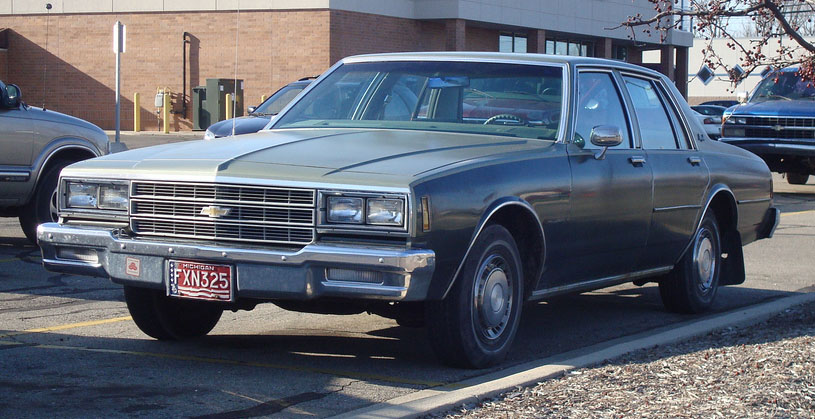
IV. Another Mountain Goats reference to the Chevy Impala, which suggests that, of American-made cars, the Impala is the most evocative:

I. From Raymond Carver's "Why Don't You Dance?":
Weeks later, she said: "The guy was about middle-aged. All his things right there in his yard. No lie. We got real pissed and danced. In the driveway. Oh, my God. Don't laugh. He played us these records. Look at this record-player. The old guy gave it to us. All these crappy records. Will you look at this shit?"II. From The Mountain Goats' "Estate Sale Sign":
crude little wooden idols and aviator shadesIII. The trailer for "Everything Must Go," which is ostensibly an adaptation of (I):
the trinkets and the treasures we brought back from the crusades
some guy in an impala shakes his head when he rides by
but i remember when we shared a vision, you and i
IV. Another Mountain Goats reference to the Chevy Impala, which suggests that, of American-made cars, the Impala is the most evocative:
once a week i make the driveV. A Chevrolet Impala:
two hours east to check the
austin post office box
and i take the detour
through our old neighborhood
see all the
chevy impalas
in their front yard up on blocks
-from "Source Decay"
01 April 2011
An uninvited guest.
I'm blogging on The Mountain Goats' new album All Eternals Deck until I feel like stopping.
I will say right away that I can't quite figure out "Birth of Serpents." I'm not enough of a superfan to scour the internet for interpretations, and since no inspiration has struck, I've got no narrative to put together the bits about photography with the apparent reference to the story of Jacob and Esau ("clutch your birthright in your fist"), nor am I sure how the snakes fit in.
But: ". . . see that young man who dwells inside his body like an uninvited guest."
In Walker Percy's Love in the Ruins, which is ultimately a little too weird and didactic for me to recommend, there is a part where a young man comes to the protagonist, who is a psychologist, for an evaluation. The young man's problem is that he can't, you know, perform his marital duties. The main character advises him to make his way home by going straight through the Louisiana swamp that lies between the office and the house. Later, we find that after the man has nearly died and has thereby put himself in a situation where he was acting more than thinking, he has no trouble doing, you know, what he needs to do. Percy maintains that the young man was too abstracted: he was living out some kind of unhealthy dualism.
I've started running again recently. And I've been pushing myself enough that I have gotten those wonderful endorphin rushes from time to time. In those moments, it's a wonder to be alive and in motion. Perhaps it's all of this happy jogging that has made me so receptive to the symposium on sports in the latest issue of The Point. (Part of one of the best essays is online.)
Several of the writers in this symposium hint at the old but good argument that the pursuit of excellence in sports makes us more at home as ourselves. It needs to be emphasized that athletics are good for us in this way when treated as active play rather than as an obligation of hygeine. In playful physicality, we're overjoyed to be bodies, not just pleased to have -- or dwell inside -- them.
I will say right away that I can't quite figure out "Birth of Serpents." I'm not enough of a superfan to scour the internet for interpretations, and since no inspiration has struck, I've got no narrative to put together the bits about photography with the apparent reference to the story of Jacob and Esau ("clutch your birthright in your fist"), nor am I sure how the snakes fit in.
But: ". . . see that young man who dwells inside his body like an uninvited guest."
In Walker Percy's Love in the Ruins, which is ultimately a little too weird and didactic for me to recommend, there is a part where a young man comes to the protagonist, who is a psychologist, for an evaluation. The young man's problem is that he can't, you know, perform his marital duties. The main character advises him to make his way home by going straight through the Louisiana swamp that lies between the office and the house. Later, we find that after the man has nearly died and has thereby put himself in a situation where he was acting more than thinking, he has no trouble doing, you know, what he needs to do. Percy maintains that the young man was too abstracted: he was living out some kind of unhealthy dualism.
I've started running again recently. And I've been pushing myself enough that I have gotten those wonderful endorphin rushes from time to time. In those moments, it's a wonder to be alive and in motion. Perhaps it's all of this happy jogging that has made me so receptive to the symposium on sports in the latest issue of The Point. (Part of one of the best essays is online.)
Several of the writers in this symposium hint at the old but good argument that the pursuit of excellence in sports makes us more at home as ourselves. It needs to be emphasized that athletics are good for us in this way when treated as active play rather than as an obligation of hygeine. In playful physicality, we're overjoyed to be bodies, not just pleased to have -- or dwell inside -- them.
Gifts of the internet.
Two things I enjoyed:
- Alexander Pruss uses Gettier cases to suggest that "memetic" accounts of belief make moral realism impossible. This is along the lines of what I've thought about the subject, but it's quite an ingenius way of putting the matter.
- Dr. Boli advises a reader on how to deal with the poor punning skills of modern clergypersons. Part of the answer: "It is probably pointless to protest to the minister or priest who authorized the sign; you would only be told 'I thought it was rather funny,' and against such profound ignorance of literary art there is no argument."
Subscribe to:
Posts (Atom)