
It's a song for Charles Bronson. You either get the appeal or you don't, I suppose.
(The picture grabbed from the awesome blog "If we don't, remember me.")
...and please forgive me for adding this:
“And then he's explaining Your Highness, as best he can. How it all started as a joke. How he and his old film-school buddy David Gordon Green [...] used to play this movie-nerd game years ago, where Green would throw out a title and McBride would start pitching him back 'f— retarded ideas for movies.'
“Green would say something like Face of Danger, and they'd come up with ‘some weird story about Steve Danger, who's a plastic surgeon and he solves mysteries.’ Your Highness was one of those. Green said it; McBride said, ‘What if I was in the Middle Ages fighting dragons and getting stoned all the time?’ ”
take care of the old man, see if he's in pain
have somebody stay with him, comfort him when he complains
keep to ourselves mostly: few friends and fewer closer friends
lead a long life if you're lucky, hope it never ends
and then the grass grows up to cover up the firepit and the forge
half a world away from the olduvai gorge
-"Sourdoire Valley Song" by The Mountain Goats
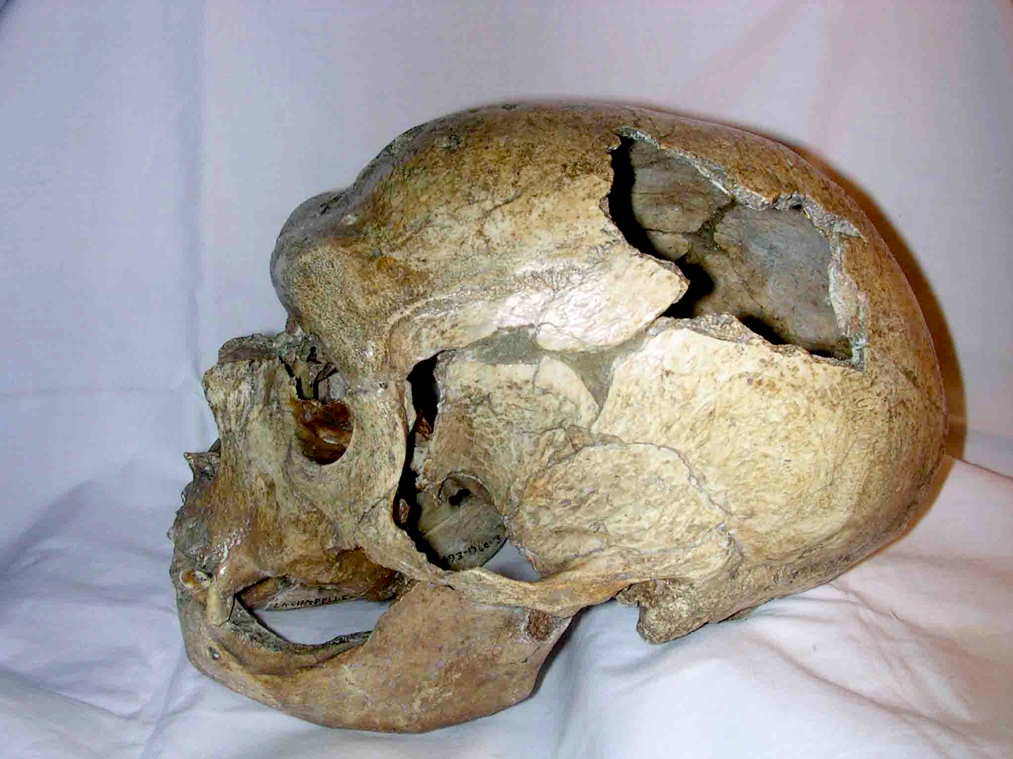
"The Old Man had lost most of his molar teeth before death, suffered from severe arthritis of the lower neck, back, and shoulders, had lived long enough to heal a broken rib, and had a badly deteriorated left hip. Without question, the Old Man had had a hard time of it."
-Erik Trinkaus and Pat Shipman, The Neandertals: Changing the Image of Mankind. New York: Alfred A. Knopf, 1993. (191)
goodbye young danish women
goodbye danish sky
goodbye cold air I am going away
goodbye goodbye goodbye
-"Tollund Man" by The Mountain Goats
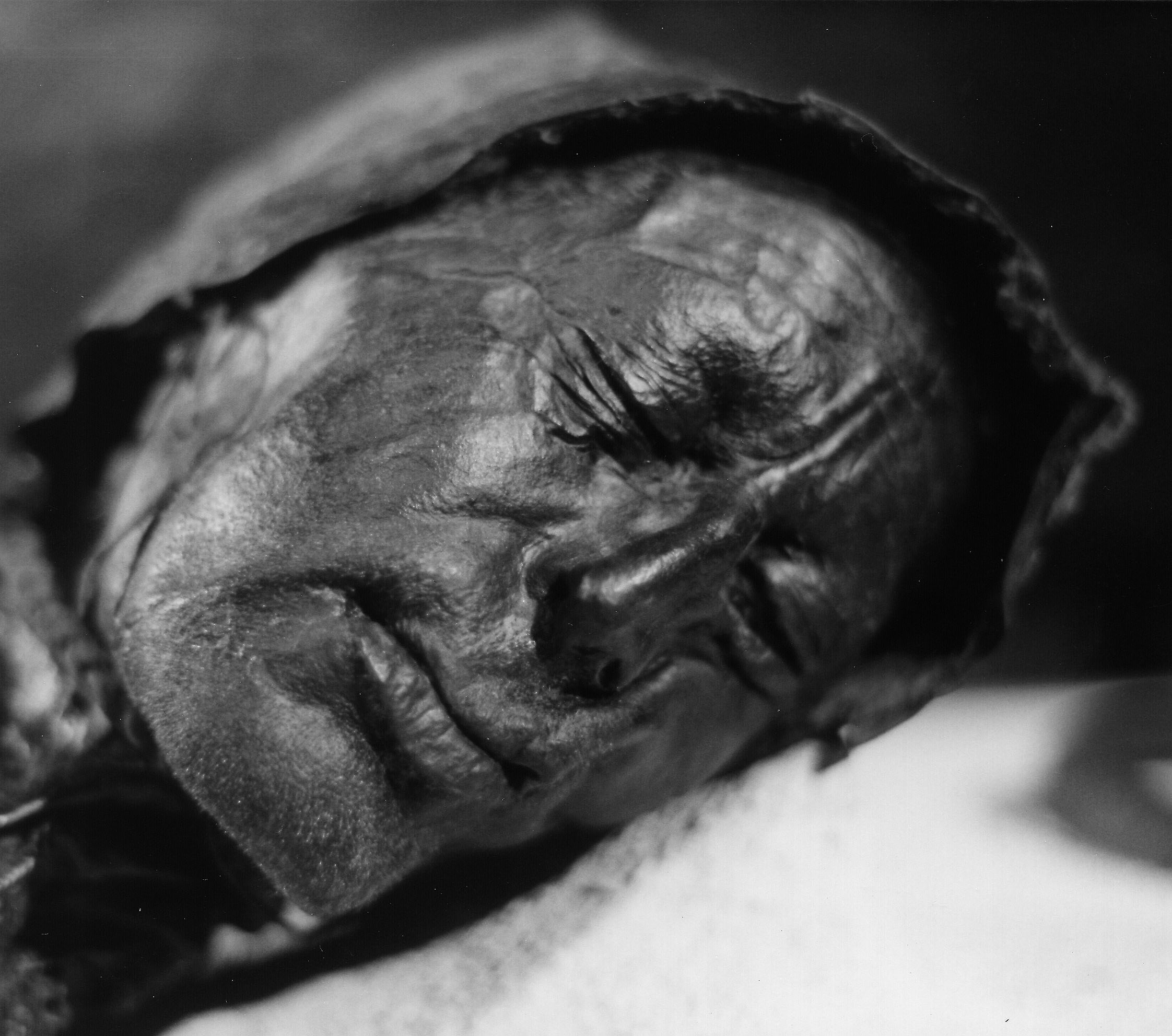
“The features are all intact in skin tanned black by the humic acid of a type of 'sour' bog found only in north-west Europe. You look on a man who was not unhandsome, with an aquiline nose, a well-formed mouth and lips, long in the cheek and with a good depth of brow that still shows in every furrow. Even the hat he wore, a pointed cap of pieces of sown hide, is preserved on his head. The wrinkled lids of the eyes have closed as in sleep. The face has a peaceful expression that belies the fact that his end came violently — a rope of twisted leather was round his neck. He was strangled: whether for a crime or for a sacrifice, we will never know. One thing autopsy did reveal about him is that he had a last meal of a kind of porridge.”
-Colin Simpson, The Viking Circle. New York: Fielding Publications, Inc., 1966. (44)
In Christ—-in the historical event of Christ—-so profound a re-orientation of moral and metaphysical perspectives has been introduced into history that all our understandings of nature, of holy law, and of moral obligation have been shaken to their foundations. One must first dwell in the sheer wonder of that event before one then tries to make sense of what it demands of us.
-David Bentley Hart, The Power of the Sword, at First Things
"Behold, You have driven me this day from the face of the ground; and from Your face I will be hidden, and I will be a vagrant and a wanderer on the earth, and whoever finds me will kill me."And the refrain of the song:
and i feel guilty but i can't feel ashamedAs I've said before, I'd love it if more Christian songwriters took their cues from this.
prowl through empty fields great cain
Today, it seems to me, there is no such truly common cultural currency. Instead, there is currency shared among small groups of initiates into certain mysteries, often meant to exclude others as much as to include the like-minded. This is what song lyrics and South Park quotes are for, after all.When it comes to dropping unexplained references in hopes of picking out fellow insiders, I'm a great sinner, if not the chief. (My only Google Chat status that doesn't fall under this indictment is "lunchtime.") But I suppose another somewhat less plausible -- but surely not impossible -- motivation would be to try to provide your friends little moments of wonder at the unfamiliar.
we hold hands and we jumpAnd here's one from "Age of Kings," about which I wrote two days ago.
and as we fall we sing
paupers hammering the walls of the castle
going to meet the king
halls of the stone tower in the foothillsAnd here's an instruction not to sleep in the refrain of "Beautiful Gas Mask":
why should we hide from anyone
held you in my arms for the first time that day
felt like god's anointed when you didn't push me away
gold light shining on so many things
in the age of kings
never sleep, remember to breathe deepThe refrain of "High Hawk Season," which I'll write about tomorrow:
never sleep, remember to breathe, breathe deep
rise if you're sleeping, stay awakeAll Eternals Deck is not a concept album in the sense that all the songs are all about a particular place or group of people, but it's stuff like this -- the image of kings, injunctions not to sleep -- that seems to give the lyrics some thematic cohesion. On the other hand, could John Darnielle's way of writing give you similar connections across any random collection of his songs? Anyways, catching these cross-references is changing my initial impression of the album as a tad disjointed.
we are young supernovas and the heat's about to break
In 1936 Margherita Piazzolla Beloch, an Italian mathematician at the University of Ferrera, published a paper that proved that starting with a length L on a piece of paper, she could fold a length that was the cube root of L. She may not have realized it at the time, but this meant that origami could solve the problem given to the Greeks at Delos, where the Oracle demanded that the Athenians double the volume of a cube. [...] It also followed from Beloch's proof that any angle can be trisected--and this cracked the second great unsolvable problem of antiquity. Beloch's paper, however, remained in obscurity for decades, until in the 1970s the math world began to take origami seriously.
[...]
As it turns out, origami is more versatile than a ruler and compass, for example, in constructing the regular polygons. Euclid was able to draw an equilateral triangle, square, pentagon, and hexagon, but recall that the heptagon (which has seven sides) and the nonagon (nine) eluded him. Origami can fold heptagons and nonagons relatively easily, although it meets its mach with the 11-agon.
-Alex Bellos, Here's Looking at Euclid: A Surprising Excursion Through the Astonishing World of Math. New York: Free Press, 2010. (67)
Weeks later, she said: "The guy was about middle-aged. All his things right there in his yard. No lie. We got real pissed and danced. In the driveway. Oh, my God. Don't laugh. He played us these records. Look at this record-player. The old guy gave it to us. All these crappy records. Will you look at this shit?"II. From The Mountain Goats' "Estate Sale Sign":
crude little wooden idols and aviator shadesIII. The trailer for "Everything Must Go," which is ostensibly an adaptation of (I):
the trinkets and the treasures we brought back from the crusades
some guy in an impala shakes his head when he rides by
but i remember when we shared a vision, you and i
once a week i make the driveV. A Chevrolet Impala:
two hours east to check the
austin post office box
and i take the detour
through our old neighborhood
see all the
chevy impalas
in their front yard up on blocks
-from "Source Decay"

feast like pagans, never get enoughIt's a great opening track for this album.
sleep like dead men, wake up like dead men
and when the sun comes try not to hate the light
someday we'll try to walk upright
crawl till dawn on my hands and knees
god damn these bite marks
deep in my arteries
crawl till dawn on my hands and knees
god damn these vampires
for what they've done to me
“The gospel tells about Jesus as the future, and in doing so impresses him on the hearers as a future for which they may live, calls up and evokes the coming Lord as the Lord of their present. Therefore, the gospel can never be only statements about Jesus; the gospel depends on the creative, future-evoking power of language. Of course, our ordinary language — whether of words, gestures, purely didactic pictures, or whatever — is itself more than descriptive, and will, therefore, often suffice for the telling of the gospel. But the church seeks to intensify the future-pointing power of its talk about Jesus; as a result, the church finds itself singing, rhyming, depicting, dancing, and playing his story.”Essays in Theology of Culture is my first attempt to get into Robert Jenson's work. So far I'm finding a lot to like.
-Robert Jenson, “Language and Time.” Essays in Theology of Culture. Grand Rapids: Eerdmans, 1995. (4)
The A.V. Club: What did you tell [Nicolas Cage] about how to play the character?Bad Lieutenant: Port of Call New Orleans is not a great movie, but it is amazing in its own way.
Werner Herzog: You see, with actors, normally I don’t like to have any conversation about background and about motivations and all this. I think on the first or second day of shooting, Nicolas, who is a very shy man, came to me and said “Werner, I know you hate these kind of Lee Strasberg Actors Studio questions about motivation, but what makes him so bad? Is it the drugs? Is it Katrina? Is it his injuries?” And I said, “Yeah, well, let’s not discuss that. But there’s such a thing as the bliss of evil. Let’s go straight for that. Enjoy yourself as much as you can, doing the worst thing, the most debased and vile things, but enjoy yourself, because the audience will somehow, I hope, be in a secret conspiracy with you that sometimes we love to be vile and debased.” It’s a secret joy, and that makes it so hilarious, I think.
